The Sham Plain Packs Consultation and Andrew Black

I hope you have you have been able to catch my piece in The Commentator on minimum priced alcohol and the plain cigarette packets. If not here it is.

http://www.thecommentator.com/article/1746/government_pouring_our_money_down_the_drain_and_rigging_health_consultations_

The government is wasting our money; Nicola Sturgeon, the SNP’s Deputy First Minister and Cabinet Secretary for Health, amongst others, and Andrew Lansley too. The “something must be done” camp has squandered millions on pounds on eye catching consultations and initiatives – never mind that we are £1trillion in debt.

The first exhibit is minimum priced alcohol (MPA) – a regressive tax on the poor that will have no real effect on consumption, and will simply force problem drinkers to make savings elsewhere, probably by eating less or spending less on utilities. It has been suggested, quite rightly, that it may even lead to an increase in aggressive begging or, at worst, crime.

Cameron said on March 23rd, 2012, “we [need] to get to grips with the problem of super-cheap alcohol that’s fuelling violence on our streets and causing mayhem in our Accident and Emergency Units and damaging the health of the country. And I think this minimum unit pricing is a big part of the answer.”

Similarly, Nicola Sturgeon opined, “The Scottish government believes that minimum pricing will save lives and reduce the harm caused by alcohol misuse.”

You may have also spotted that MPA kicked off at 40p and was ratcheted up to 50p before the ink was even dry on the Act. Northern Ireland Executive members and puritans, Michael McGimpsey and Alex Attwood, thought 70p more suitable.


It is interesting that, according to the Home Office, ‘Johnny the Chav’ is forced to pay at least £6.00 for his cider while Cameron and his chums – if they can find it – could get change from a fiver for a bottle of champers.  I also note that the cost of treating alcohol-related diseases was quoted as £2.7 billion, while they fail to mention that receipts in taxation plus VAT are £10.6 billion.

So we’ve had the idea, civil servants have drafted response papers, hours have been spent by the private sector wasting resources in replying and making trips to Parliament to lobby, before more time spent by civil servants drafting the legislation, and by MPs scrutinizing the bill and debating in Parliament. Oh, and let’s not forget private enterprise which has had to implement the lunacy: relabeling bottle prices and ticking more boxes. And for what? Not a speck of difference.

Millions of pounds has been spent on useless and ineffective bureaucracy to keep Sir Humphrey Appleby – Yes Minister’s Machiavellian and manipulative civil servant – and his minions in a job. This is public sector carnage.

Well before the mountain of pulp had started to stack up, Dominic Grieve MP, the Attorney General, warned Cameron that under European Law Articles 34 and 36, the Treaty on the Functioning of the European Union it was illegal.

Nicola Sturgeon was told as early as December 2011 by The Law Society of Scotland – they even cited the case of European Commission v France, Austria, and Ireland (C197-08, C198/08 and C221/08) where those Member States fixed minimum retail prices for cigarettes. The Court held that the legislation in France, Austria, and Ireland, fixing minimum retail prices for cigarettes, infringed European Union Law. After complaints from Spain, Italy, Portugal and Bulgaria, MPA is dead in the water.

Arrogance or stupidity? Will there be resignations, apologies, and compensation to private enterprise?

For the second exhibit, we turn to plain packaging for cigarettes.

Sir Humphrey for tobacco at the Department of Health is Programme Manager Andrew Black, an Australian. Despite being a supposedly neutral civil servant, he is an open advocate of the tobacco control industry who has spoken alongside his chums from Action on Smoking such as Professor Robert West – a Professor of Health Psychology and Director of Tobacco Studies at UCL – and taxpayer-funded junk scientist extraordinaire, Linda Bauld – who believes the smoking ban did not close any pubs.

PlainPacksNZ tweeted on the September 23rd: “The UK Government intends to schedule plain packaging within 6 months.”

Also on Friday July 13th, Plain Packs Protect listed Health Secretary Andrew Lansley as a supporter. This is a man who was meant to be entirely neutral and who was not meant to have an opinion before the consultation had ended, let alone begun.

The government was badly mauled in the vox pop: 500,000 against plain packs versus 235,000 for. The Programme Manager for Tobacco Control (PMTC) — the only one I know of is Andrew Black – wrote to Simon Clark of Forest on Thursday June 14th asking for “…detailed information about the collection of signatures. Sample questions included:

Did you engage any agencies or contractors to collect signatures?

How many individuals have been engaged to collect signatures?

Where have those collecting signatures been located?

They then go onto suggest that the workers were fraudulently filling in names themselves.

On Tuesday June 19th my “mate”, Australian anti-smoking advocate Professor Simon Chapman tweeted “UK anti #plainpack petition collectors seen filling in screeds of made up names. Laughable amateurs.”

Clark’s letter was not published on the Department of Health website until September 13th. Of course these could be complete coincidence — but a remarkable one, n’est-ce pas?

Of course Sir Humphrey could be blatantly misleading us too and smearing Forest’s campaign. If the PMTC, Andrew Black, is leaking information, then he should resign.

It certainly seems the Antipodes knows more than us. If that is the case the consultation is a biased sham, has no democratic mandate, and is a monstrous waste of public money.

Private enterprise has to spend turnover and profits on Quixote causes. The PMTC says in his letter “I have responsibility for the tobacco packaging consultation… I will also have responsibility for the analysis of the consultation responses and for supporting ministerial decision making on tobacco control policies in the future.”

Yes Sir Humphrey.

David Atherton is Chairman of Freedom2Choose, which seeks to protect the informed choices of consenting adults on the issues of smoking. Follow him on Twitter: @DaveAtherton20


Posted in Alcohol, Smoking | Tagged | 2 Comments

Wind turbines, unsightly, expensive but are they also a health risk?

Wind turbines, unsightly, expensive but are they also a health risk?

I have a small confession to make, I am a bit of a closet Green. My rubbish is carefully sorted out for recycling, I walk and cycle to the shops and the bulldozing of the British countryside for buildings makes me feel uneasy. Not that I have a photograph of Green God George Monbiot next to my torn and faded one of Che Guevara, but I do not like waste. There is a strong case for renewable energy in that it will make us a lot less reliant upon oil from the politically unstable Middle East and who knows the Iraq invasion may not have happened. The UK is the windiest place in Europe and gives the country an unlimited source of energy.

Just before you think I am writing love letters to Caroline Lucas, and one of James Dellingpole’s Watermelons, green on the outside and red on the inside, there is much to detract from wind farming. The costs of generating 1 Megawatt hour (MWh) of electricity is for gas £65 and coal is £62, nuclear £95. Onshore wind £90 and offshore wind an eye watering £150. However, it is possible that like mobile and smartphone batteries, research and development could make them more efficient. As mentioned here by the Montana Environmental Information Center: “Turbines are much larger, growing from an average of 1.2 megawatts to 1.6 megawatts (a 33% increase in average capacity) in just three years. Today’s typical new turbine has a 2.3-megawatt capacity; 7-megawatt turbines will be available soon.”

However a disturbing paper from The King Juan Carlos University found in 2009 that “Spain’s experience cited by President Obama as a model reveals with high confidence, by two different methods, that the U.S. should expect a loss of at least 2.2 jobs on average, or about 9 jobs lost for every 4 created, to which we have to add those jobs that non-subsidized investments with the same resources would have created.”

As I previously mentioned about concreting the countryside wind farms have brought out the NIMBYs. UKIP’s Energy Spokesman Roger Helmer is a leading critic. It has also attracted the opprobrium of the National Trust their Director Of Conservation Peter Nixon, said: “The National Trust position remains unchanged.  We have a duty to protect beautiful places, and believe that any wind energy proposals should be located, designed and on a scale that avoids compromising these.”

Wind power now has a major new headache, pun intended in the shape of the health of the people who live in the vicinity of wind farms. I have been given an exclusive interview with Canadian Professor Carl V Phillips.

Perhaps you could give The Commentator a background to your career so far?

I was a professor of public health for about 15 years, working on a combination of epidemiology, public policy, and environmental health.  Before I went to graduate school, I did some work for the electric power industry.  Currently I run my own university-style research shop, and do economic and epidemiologic consulting.  I have been working on the IWT issue for about 2.5 years.
I understand that there maybe health risks associated with living near wind turbines can you expand on that?
There is a consistent pattern of many people who live near (Industrial Wind Turbines) IWTs suffering from a class of diseases caused by chronic stress reactions:  insomnia, fatigue, headaches, inability to concentrate, mood disorders (e.g., depression or being quick to anger), and the like.  It is likely that this reaction creates cardiovascular problems too.  It is not too surprising that this occurs, since some (not all) people will have an ongoing “fight or flight” reaction to certain types of noise, and IWTs produce types of noise (cyclic and low-frequency) that are known to be especially disturbing.

There are other alternatives proposed for the causal pathway, such as non-stress-mediated effects via the ears (both hearing and the balance system), which might explain particular symptoms like balance problems and tinnitus.  But whatever the causal pathway, the effects are quite clear.

In terms of severity, a large portion of the exposed population apparently experiences some of the problems to a bothersome extent, and a few percent experience problems so severe that it basically destroys their lives.  Or it forces them to flee their homes.  Their homes then end up selling at prices well below what they would be worth if there were no nearby IWTs, if they can sell them at all; that loss in value is a good measure of how substantial these negative effects are to people.
What kind of evidence from medical papers that this is the case?
The vast majority of the evidence is not in medical papers, but is in the form of thousands of individual “adverse event reports” — volunteered information by individuals reporting on their own diseases.  This is the type of monitoring that informs us about unexpected drug reactions and anything other adverse reaction to something that was not expected.

Systematic study has been limited because it depends on volunteer work from the community.  Normally we would require that an industry fund independent research into the risks of an exposure they were imposing on people, or the government would fund the studies.  But in this case the government is complicit in the problem and so no one is requiring the energy industry exercise the due diligence that would be demanded for, say, a pharmaceutical or agricultural chemical.  A tiny fraction of the subsidies (paid by us, of course) to the energy industry to support these projects would be enough to do plenty of systematic studies, so no one can claim that there is no money available.  There is just a concerted effort to avoid gathering evidence.

That said, this does not keep us from having very good evidence in this particular case.  The nature of this exposure and the diseases it causes give us a case where adverse event reports are more informative than population surveys and averages.  Individuals are able to “cross over” from being exposed to unexposed (by spending time away from home, or when there is no wind for long periods) and the disease go away.  So a large portion of the adverse event reports include people doing that experiment and discovering that when the exposure is removed, the disease disappears, but when the exposure is resumed the disease recurs.

Such scientific reasoning seems to baffle a lot of people who are only capable of reading the conclusion statement of article abstracts.  But if you ask any real scientist — or a moderately intelligent 12-year-old — to interpret that evidence, and they will immediately recognize that this real-world experimental evidence is more informative about causation than subtle statistical differences between populations.  Apparently some people lose the reasoning ability of 12-year-olds when they are paid to do so.

That said, there is evidence in medical papers and systematic studies.  It confirms what we know from the adverse event reports and their crossover studies.  Indeed, there is enough such evidence that if this were, say, industrial chemical pollution, the environmentalists and public health activists would be demanding bans, and some probably would have already happened.

Does that mean that the evidence is mostly not peer reviewed?

That is correct.  But this does not really matter.  Some who want to deny the scientific evidence do not understand that peer reviewed publication is mostly just a scorekeeping method for professors (while others pretend to not understand because that supports their rhetoric).  The most serious sciences have long sense moved away from this model.  The peer review process in health science is really mostly editorial, not scientific.  Reviewers never see the data or even know most of the methods that were used, and they certainly cannot audit the data collection process to make sure it is accurate.  They see only what you eventually read in a journal, so obviously they cannot provide any more of a review than any reader of the article can.

It would be possible to take the adverse event reports and publish them in a peer reviewed journal, but why?  That would obviously not make them any more or less credible (indeed, I did this with a few of them, just to make that point).  The same is true for any statistics-based study, though these tend to end up in journals so that the authors can get credit for them.  But it does not make them any more likely to be good science.
Is there any evidence that the health risks could be psychosomatic?
This is the claim that the industry and their hirelings have fled to, now that they can no longer get away with claiming that there are no effects.  They blame the victims.  It is a standard ploy.

A favorite claim is to suggest that because there is evidence that some people irrationally fear certain invisible health hazards (“toxic chemicals” and radiation, in particular), and there are a few documented cases of that fear apparently causing groups of people to report symptoms, that this is what is happening with IWTs.  But this just a legalistic ploy, not a scientific claim (compare, for example, the claims made by cigarette companies when they are sued by a lung cancer victim).  To say this might be happening is just a speculative hypothesis, and no one has ever produced a shred of evidence to support it.  If defending against a lawsuit, throwing out a speculative alternative explanation is standard practice, but it should not be taken seriously in making public policy decisions, let alone drawing scientific conclusions.

Moreover, even as speculation this claim is absurd on its fact:  a phenomenon that occasionally causes a self-feeding mass hysteria in a small community could not affect thousands of people who have never communicated in any way; people do not react to a simple observable exposure (noise from a machine waking them up at night) with the vague fear they have about invisible carcinogens.

The evidence clearly shows that the effects do not fit the typical interpretation of “psychosomatic” — that the disease exists only because people think it is exists.  There are a lot of people who were quite sure there was no risk, or who embraced the installation of IWTs, who then found they were suffering from the diseases.

Those who want to deny the science like to play word games, taking advantage of the fact that stress reactions are mediated through the subconscious mind, and suggesting that somehow this means the diseases are not “real”.  But the diseases that do more damage to people’s quality of life than any others — depression and chronic pain — are entirely “in people’s heads”.  The involvement of the mind does not mean that people can just decide to not have the diseases any more than they can decide to not have an infection.  If there were a way to make the diseases stop happening or go away through psychological intervention, that might have some implications for what we should be doing.  But since no such intervention has ever been seriously proposed, let alone demonstrated to work, the whole point is rather moot.

I think that anyone who claims “these problems exist only in people’s heads, so we should not worry about them” should pledge to never take an analgesic and to refuse anesthesia for dentistry or surgery.  After all, the pain sensation is something that exists only in their heads.
What should be done about wind turbines?
The health risks are clearly established by the evidence. What is needed is a complete cost-benefit analysis of this whole endeavor.  There is no analysis out there that shows that installing IWTs makes any sense, all costs considered, and the failure to show that means that this is all just lunacy from the perspective of good public policy.  (I suppose, more precisely, such an analysis has never been reported.  Presumably the industry has done the analysis and would have reported it if they like the results, but decided to suppress it because it looks really bad for them.)  Such an analysis would compare the energy contribution of IWTs (the net contribution, that is, after accounting for the inefficiencies that come from having a power source that “decides” for itself when to turn on) to the costs of production and installation, as well as the health costs and the horrible environmental impact.

It is a potentially valid argument to say, with quantification, “yes, there are costs, and here they are; but here are the benefits justify the costs, including the harms to people’s health”.  In free countries we usually demand very positive net benefits before we inflict harm on innocent victims, but sometimes that is considered justified.  However, given that the IWT industry and proponents do not try to make such an argument, but rather seek to deny that there are any costs (health, environmental, electric grid efficiency loss), and refuses to even quantify the claimed benefits, it is pretty clear that they do not think an honest analysis supports their position.”

One of the proponents for wind farms is none other than my old sparring partner Professor Simon Chapman of Sydney University. In this article he says: “I started collecting examples of health problems some people were attributing to wind turbine exposure. I had noticed a growing number of such claims on the internet and was curious about how many I could find. Within an hour or two I had found nearly 50 and today the number has grown to an astonishing 155.” He certainly has done his research to be fair. Many of the papers are sceptical of the health claims although one Professor Chapman cites from the Australian government’s National Health and Medical Research Council stated that: “Another study of residents living in the vicinity of wind farms in the Netherlands found that annoyance was strongly correlated with a negative attitude toward the visual impact of wind turbines on the landscape. The study also concluded that people who benefit economically from wind turbines were less likely to report noise annoyance, despite exposure to similar sound levels as those people who were not economically benefiting.” At worst they at least acknowledge there appears to be some affected people.

There is some evidence that world temperatures peaked in 1997 and we could even possibly be in for a period of global cooling. Wind farms need to make a case for their economic viability, the sighting of wind farms a matter for local democracy.  Certainly the green agenda should not be economic or cultural Marxism. As one of papers mentioned by Professor Chapman from the  UK’s Health Protection Agency states:  “These included..noise from wind farms.. We accept that these are all subjects that are in need of study, but we were not able to take them into consideration in our work, at least not in detail, due to constraints on time and on the effort available.”

Professor Carl Phillips raises some serious questions on the health of people exposed to wind farms, maybe it is time to have his empirical evidence properly investigated. The politically correct agenda of the greens is no reason to investigate further.

http://www.amazon.co.uk/Watermelons-Environmentalists-Destroying-Stealing-Childrens/dp/1849542171

http://www.civitas.org.uk/economy/electricitycosts2012.pdf
http://meic.org/issues/montana-clean-energy/cost-of-wind-vs-fossil-fuels/

http://www.juandemariana.org/pdf/090327-employment-public-aid-renewable.pdf

http://www.guardian.co.uk/commentisfree/2011/may/26/bravo-for-the-nimbys-wind-power

http://rogerhelmermep.wordpress.com/2012/06/26/the-persistent-mythology-of-wind-power/

http://www.nationaltrust.org.uk/what-we-do/big-issues/energy-and-climate-change/our-views/view-page/item749709/

http://theconversation.edu.au/wind-turbine-syndrome-a-classic-communicated-disease-8318

http://www.nhmrc.gov.au/_files_nhmrc/publications/attachments/new0048_evidence_review_wind_turbines_and_health.pdf

http://www.hpa.org.uk/webc/HPAwebFile/HPAweb_C/1279888026747

http://www.forbes.com/sites/peterferrara/2012/05/31/sorry-global-warming-alarmists-the-earth-is-cooling/

Posted in Uncategorized | 3 Comments

Five years after the smoking ban we are all smokers now

I hope you are reading The Commentator an online magazine newspaper for which I am an ‘umble writer. Covering politics and economics in the UK, USA and the rest of the Anglo-sphere, it is described as “conservative and libertarian news, opinion and blogs. Established April 2011 by @RobinShepherd1, @RaheemJKassam & @DaneVallejo they have some damn good writers, me excepted.  Here are the Facebook and Twitter links.

http://www.facebook.com/thecommentatorcom

https://twitter.com/TheCommentator

So I thought I would post one of my articles and give you a sneak preview of next weeks. Next week’s piece is on the liberalisation of prostitution and gambling.

“Las Vegas …. reluctantly in sympathy with many American States made gambling illegal on October 1st 1910. Not to be outdone inevitably the underground gambling industry flourished and like Alcohol Prohibition a secret password was needed to get in. “

“Firstly fifty five police forces in the UK took part in operation Pentameter 1 to track down trafficked women working in prostitution. Out of an estimated 80,000 sex workers, 88 or 0.11% were victims.”

Now my article on the smoking ban.

http://www.thecommentator.com/article/1365/five_years_after_the_smoking_ban_we_are_all_smokers_now

When I was asked to write articles for The Commentator I was determined not to bang on about smoking. However, five years after the ban came in on July 1st 2007, it seems relevant to raise my head above the parapet.

My thesis and hence the title, that flushed with the ‘success’ of smoking restrictions, a tidal wave of non-governmental organisations (many state funded charities), ‘something must be done’ politicians and an all-too-compliant population have opened themselves up to their own version of stigmatisation, vilification and Acts that receive the assent of the Queen.

The ultimate irony is we have the Guardianista, left wing, Islington dinner party set sanctioning state led bigotry against smokers.

In a remarkable paper by Professor Hilary Graham, commissioned by the Department of Health, society’s attitudes toward smokers is reviewed. It makes grim reading. Smokers are now a despised underclass. She does not mince her words in comparing the plight of smokers to racially discriminated immigrants.

“Across the 19th and 20th centuries, poorer communities, including migrant and indigenous groups, were cast as the contaminating other whose habitual behaviours were seen to threaten ways of life that were in contrast presented as normal and desirable.”

The history of public health is scarred by policies which, pursued in the name of health protection and promotion, have served to intensify public vilification and state-sanctioned discrimination against already disadvantaged groups.

The smoking rates between the classes are 14 percent for the middle classes and 28 percent for the working classes and they have also been most affected by pub, bingo hall and Working Men’s CIU club closures and subsequent unemployment. The ban has led to upwards of 10,000 pubs closing which would be trading if smoking was still allowed.

The British pub’s Bible, the Publican’s Morning Advertiser, even before the ban was one year old in April 2008 said, “as many as 78,000 full and part-time jobs may have been lost if the survey results replicate the situation across the 50,000 pubs in England and Wales.”

What has been one of the more corrosive aspects of the Tobacco Control Industry is the abuse of science. The heart attack ‘miracles’ invented by Professor Jill Pell of Glasgow University and Professor Anna Gilmore of the University of Bath are a prime example. Pell’s study was awarded top ten status in The Times’ ‘The worst junk science stats of 2007.’

Professor Pell was guilty of selecting the months and hospitals she chose for the study. Professor Anna Gilmore was guilty of describing a methodology in her paper and then appearing to abandon it. Her paper in the British Medical Journal said ‘Conclusion. This study adds to a growing body of evidence that smoke-free legislation leads to reductions in myocardial infarctions.’

The three years preceding the smoking saw drops in acute myocardial infarction of 1.33 percent, 3.1 percent and 5.19 percent. Post ban 3.21 percent and 4.26 percent. Draw your own conclusions.

It would be also be pertinent to comment on the social isolation and dislocation caused by the smoking ban, especially the aged and infirm. Do you really expect an eighty year old pensioner to hobble out on their walking sticks in the middle of January to puff on their pipe? The pub, bingo hall and CIU clubs might have been their only interaction outside their home.

As I infer at the start of the piece, if you do not smoke but like a drink and have love handles, Pastor Niemoller is preaching at your door; the neuro-linguistic programming speak is coming to a place near you.

A leader in the Guardian, from Friday June 29th, was sub titled ‘The smoking ban was far too long in coming – and the next campaign for public health will be harder still to sell.’ (I am sure they will try their best.) And went on to say, “the next campaign for better public health is in a different league. Alcohol and obesity – what we eat and how much we drink – these are the stuff of our very souls.”

The Royal College of Physicians wrote in 2007 “The ‘passive effects’ of alcohol, misuse are catastrophic – rape, sexual assault, domestic and other violence, drunk driving and street disorder – alcohol affects thousands more innocent victims than passive smoking.”

We also have this gem: “Supermarkets are exhibiting the morality of a crack dealer”, House of Commons Select Committee on Health as told by Professor Martin Plant.

In an article by Dennis Gottfried, M.D. entitled ‘Anti-Smoking Tactics Can Squeeze Obesity’ he opines: “When people with whom we are closely associated gain weight, such as a spouse, sibling, neighbor or friend, we are also at an increased risk of gaining weight. For example, if your friend becomes obese, you have a 177 percent increased risk of becoming obese. If your friend’s brother becomes obese, your risk is still increased’

Yes that is passive obesity.

San Francisco has banned free toys with McDonalds Happy meals, and New York Mayor Michael Bloomberg is banning large cups of soda (fizzy drinks) in retail outlets of more than 16 ounces.

Big Pharma in the shape of The Robert Wood Foundation have funded this study, “Soda and Tobacco Industry Corporate Social Responsibility Campaigns: How Do They Compare? The conclusions included: “As they did with tobacco, public health advocates need to counter industry CSR with strong denormalization campaigns to educate the public and policymakers about the effects of soda Corporate Social Responsibility campaigns and the social ills caused by sugary beverages.”

Believe you me I am just poking a scalpel underneath the epidermis of the bully state.

Many people find smoking uncomfortable, perhaps in some cases even a little obnoxious. However after coming for the smokers, the bully state. shamelessly embraced by David Cameron, has been rolled out to you.

You too will be a second class citizen. In a phrase first coined by IEA Fellow Chris Snowdon, ‘Utopia is only one ban away.’

David Atherton is Chairman of Freedom2Choose, which seeks to protect the informed choices of consenting adults on the issues of smoking

//

//

//

//

Posted in Uncategorized | 9 Comments

Action on Smoking and Health (ASH) are proved wrong again

Five years after the smoking ban in England, the desire to reintroduce  smoking in pubs remains as high as ever. I will let the Publican’s Morning Advertiser take up the story.

“An exclusive survey of the Publican’s Morning Advertiser readership revealed 68.3% either agree or strongly agree that pubs should be permitted to have separate smoking rooms, in line with some European countries. Furthermore, six out of 10 felt there should be designated smoking and non-smoking bars.”

Even more interesting is this: “However, there was less appetite for a full repeal of the ban. Just four in 10 respondents agreed it should be scrapped.”

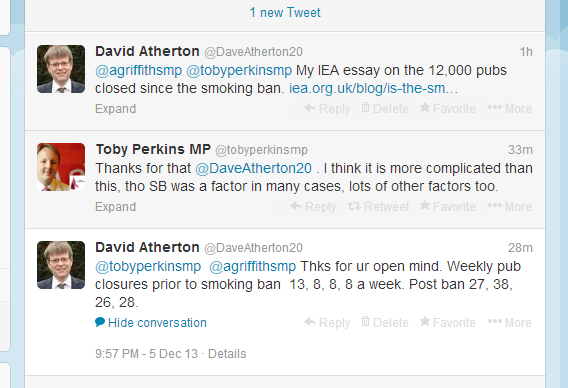
We only have to look at the closures pre and post ban to see why. From 1980 to 2006 pubs closed at a rate of 0.65% per year and 2.775% afterwards. Very much in contrast from those PHD Economists at ASH.

“Tuesday 25 February 2003

Smoking bans are good for business. Study shows hospitality industry fears of falls in trade are unfounded.”

ASH were also saying that the public were in favour of bans too. So for posterity here are some polls pre and post ban which begged to differ.

17th December 2003

“52% against smoking ban in Edinburgh. ” Paid for by Nicotinel who would gain from people giving up.

http://www.scotsman.com/news/capital-bucks-trend-on-total-public-smoking-ban-1-897602

5th August 2009

“58% of Tories want the ban amended for all pubs”

http://conservativehome.blogs.com/thetorydiary/2009/08/58-of-tory-members-support-relaxation-of-smoking-ban.html#tp

“73% of Tories want smoking ban relaxed in private members clubs.

http://conservativehome.blogs.com/.a/6a00d83451b31c69e20120a7d1a66b970b-pi

28 Jul 2004
More than 80 percent of pub customers in Wales are opposed to a complete ban on smoking in pubs according to a survey carried out for leading independent brewer, pubs and drinks company SA Brain & Co Ltd.

The independent survey of nearly 1,400 customers and staff found that only 19 percent of customers and 12 percent of staff support a total ban on smoking in pubs. There was, however, more widespread support for the provision of no smoking areas for eating and at the bar.

Around 42 percent of customers agreed that no smoking should be the policy in eating areas of the pub. Twenty-two and a half percent support banning smoking at the bar at 22.5 percent and 23 percent of customers said that they would spend more time in the pub if changes to the smoking policy were made. Around 83 percent said that the level of smoke was not a problem in the pub in which they were interviewed.

Of the total number of customers surveyed, 41 percent were smokers.
Retail director for SA Brain & Co Ltd, Philip Lay, said

http://www.sabrain.com/index.cfm?UUID=FFD5C6A8-2B30-CFB5-B7D7FD7905913320

“74% want exemptions to the smoking ban
Monday, 19 March 2007,
Three quarters of people in Scotland believe there should be exemptions to the smoking ban, a poll has suggested.  The Populus survey, for the pro-smoking group Forest, revealed 74% of 1,004 people surveyed thought private clubs should be allowed smoking rooms.”

http://news.bbc.co.uk/1/hi/scotland/6464521.stm

Posted in ASH, Smoking | Tagged | 13 Comments

SmokeFree South West do us for another £135,000

As was reported in the last week that six National Health Service (NHS) trust hospitals are on the verge of bankruptcy, they do seem still to have plenty of cash to spend on the tobacco control industry.

The University of Bath Tobacco Research Group headed up by Professor Anna Gilmore, manages the http://www.tobaccotactics.org/index.php/Main_Page and in their own words:

“TobaccoTactics (TT) is a project of the Tobacco Control Research Group at the Department for Health at the University of Bath and is overseen by two managing editors, Eveline Lubbers and Andrew Rowell.”

Never mind the site is hosted by a Dutch private detective agency Buro Jansen & Janssen. The Editor of TT Ms Eveline Lubbers is the Principal.  TT also have this disclaimer:

Disclaimer. Some of the research for TobaccoTactics was funded by Cancer Research UK Limited and Smokefree South West. These funders have had no input into the research reported on this website or its conclusions. They are not responsible for the content or the publication, nor do they necessarily endorse it. Published by the University of Bath. Read the General Disclaimer.”

So who funds SmokeFree South West (SFSW)  and how much have they committed to the project? SFSW are funded by the NHS and by definition the taxpayer. So how much are we paying towards it? A couple of weeks ago I put in a Freedom of Information Request (FOI) and have received a reply.

“SmokeFree South West paid a total of £135,000 to the University of Bath over two years for a variety of different tobacco control research related projects. There will be no future funding for this. SmokeFree South West has not funded a specific amount to this website nor will we fund a specific amount in the future. We are not responsible for the content or the publication of the website, nor do we necessarily endorse it.”

Professor Gilmore’s profile page on the University of Bath includes an admission she is receives funding from SFSW, she also gets the same from Cancer Research UK too.

In my opinion there are some serious questions to be asked by the taxpayer on where their hard earned cash goes.  TT is to be fair a reasonably accurate website and the information by and large correct. However there an antidote to it Tobacco Control Tactics which you will no doubt pleased does not receive a penny from the taxpayer and also tobacco companies. It is a grass root smokers who are fed up of the tobacco control industry.

Posted in Uncategorized | 6 Comments

Clive Bates, former Head of ASH writes on Big Pharma, snus and E-Cigs

Clive Bates was the former head of Action on Smoking and Health (ASH) . I am not entirely sure when he started, but I think 1997 and left in 2003. In Chris Snowdon’s masterpiece Velvet Glove, Iron Fist, A History of Anti-Smoking, here is a chance to buy it if you have not shamefully yet. http://www.amazon.co.uk/Velvet-Glove-Iron-Fist-Anti-Smoking/dp/0956226507

Clive’s gentle persuasion is credited with getting smoking rates down to 21% of the population.  He still is involved in a private capacity in wanting to reduce smoking rates and is an advocate of snus and e-cigarettes. Clive has been kind enough to post a couple of comments which I think deserve a broader audience.

“I’m in favour of e-cigarettes for the same reasons as I’m in favour of snus. Nicotine is a widely used drug and there is no reason to restrict its availability to only the most dangerous delivery systems. Plenty of reasons to allow smokers to adopt this alternative.”

“I stand by all of this. I was Director of ASH and we took the view then as now that smoking represents the single most serious public health problem and the biggest driver of health inequalities. Unlike the approach taken with drugs (criminalisation), we believe that a public health approach is justified – especially in the light of the addictiveness of smoking. Pharma approaches to help smokers over nicotine addiction are part of the response (if they work), but I’m as sceptical as anyone about the efficacy of pharma products. Smokeless tobacco is potentially more important given what we know from Sweden. I’ve no objection to ‘pharming’ and don’t remember voicing any.”

“It’s not a secret – we were trying to get smoke-free public places almost from the dawn of time. Huge volumes of misinformation were produced on all aspects of smoking and passive smoking by the tobacco industry and its bought up and slavish hacks. No surprise surely…”

Pharma approaches to help smokers over nicotine addiction are part of the response (if they work), but I’m as sceptical as anyone about the efficacy of pharma products.

Ouch!!

Thanks Clive for your frank comments.

http://daveatherton.wordpress.com/2012/04/22/clive-bates-former-head-of-ash-on-snus-hat-tip-chris-snowdon/#comments

Posted in Uncategorized | Tagged , | 11 Comments

“Plans for plain packaging of cigarettes are a charter for organised crime and a danger to our children”

So says Peter Sheridan is a former Assistant Chief Constable of Northern Ireland. In an article in the Daily Mail he concludes by saying:

“This well-meaning proposal, intended to make more of our young people safe and healthy, will actually make it easier for criminals to threaten the well-being of those closest to us.”

Also you can catch me and Mick Walker of Nothing-2-Declare were on BBC Radio Humberside this morning. The feature starts with the UKBA at 0.08.30 in and we are on from 0.23.19.

http://www.bbc.co.uk/radio/player/p00tbnkf

Here is the article on full.

“With over 30 years’ experience policing organised crime on the streets of Northern Ireland, I know how damaging the scourge of tobacco can be for every single community; every family.

I like to think I approach any issue with an open mind, and that of the Government’s consultation on plain packaging is no different, but right now in Northern Ireland one in every five packs of cigarettes is illegally sourced, and this money goes into the pockets of organised crime. It may sound far-fetched, but that is the truth. Put simply, my fear is that introducing plain packaging for cigarettes will make life easier for  criminals, while those policing our streets will have a much tougher time: instead of having 200 different designs of packs to copy there would be just one.

The problem is that all too often people with good intentions don’t stop to think about the wider impact their policies will have. In Germany, over the last 10 years, smoking rates in the young have plummeted from 27 per cent to just 11 per cent as a result of public education campaigns. By comparison, in Ireland, which has some of the toughest smoking regulations in Europe, the overall smoking rate has only dropped by 5 per cent over the same period.

The fact is, banning cigarette logos might actually make things worse. Plain packets could be a smugglers’ charter. I’ve spent most of my working life as a senior police officer in Northern Ireland, where organised crime gangs and terrorist organisations have turned smuggling knock-off fags, jewellery and clothing into a multi-million pound black market business, alongside their prostitution rings and drug running operations.

Because of the power of these gangs the supply chain for counterfeit cigarettes stretches across Europe and beyond. Millions of pounds each year are spent on law enforcement measures to counter their activities.

Despite this, it is a growth industry with damaging effects on society. Last September over £2 million of counterfeit tobacco heading for the UK market was seized in Dublin. Over 10 per cent of the cigarettes sold in the UK are now imported illegally, and across the border it’s even higher. A worrying amount of these are fakes rather than genuine cigarettes illegally imported.

It is conceivable that the introduction of plain packaging will make it more difficult for police to detect fake fags, which have been shown to contain all sorts of weird and unpleasant ingredients.

Many people have said smokers are naturally drawn to branded cigarettes, which is why logos should be banned. But plain packaging will create a bizarre situation – where branded cigarettes are the tobacco products of choice on the black market. If we hand the control of branded goods to criminal gangs, we could actually be aiding them in their illegal trade.

I know the taxman isn’t always popular, but without the money from cigarettes and tobacco – currently £12bn a year – taxes will have to rise or other government spending shrink. Smuggling of tobacco already costs the UK £3.1 billion every year: cash that could go towards schools, hospitals, creating new jobs or even the police.

I don’t want us to make a mistake that is one step away from banning cigarettes. As America saw when it banned alcohol nearly a hundred years ago – a policy known as “Prohibition”, it creates an environment where gangsters and lawlessness thrive, causing chaos for the honest majority – and it’s the police who end up having to clear up the mess.

Everyone knows teenagers try smoking because of peer pressure – it’s friends and the groups they mix in that leads them to start smoking, not cigarette logos. But if you take away logos and make fag packets more extreme, there is a real danger of making smoking even more attractive to impressionable young people wanting to stand up to authority and rebel.

We mustn’t rush into introducing plain packaging. This well-meaning proposal, intended to make more of our young people safe and healthy, will actually make it easier for criminals to threaten the well-being of those closest to us.

Posted in Smoking | Tagged | 5 Comments